

The best set of questions to ask a marketing agency we’ve ever received came from a prospect who sent us 17 of them, in writing, about our audit. She asked for the raw map data behind every grid point, the math behind our break-even figure, local numbers instead of national ones, and which AI tools we checked and on what dates. She also didn’t want her $750 budget split across four campaigns.
One of her catches changed our math. Our break-even figure used gross revenue and left out ad spend, and she was right to flag it. We answered all 17 questions. She signed, and told us: “I honestly didn’t think you were going to do all those questions, but I really do appreciate it.” At William & Friends, we think every practice owner should vet an agency this way, us included, and we’ve tried to make how we work easy to check.
TL;DR
Hiring a marketing agency is a trust decision, and you can make it with evidence. Before you hire, ask for the raw data behind every number, check that any break-even math includes ad spend, ask whether figures are local or national, ask which AI tools were checked and when, ask whether they can report from inquiry to retained client, and ask why they’re splitting your budget the way they are. Be skeptical of paid awards. After you hire, open your Google Ads account and look at the change history, the placements, the locations your ads run in, and every term on your negative keyword list. Finally, make sure your practice owns every account and that each vendor has its own login and a signed BAA before touching anything.
Key Points
-
Ask for the raw data. Any number in a proposal should have something behind it.
-
Check the math. A break-even figure should include ad spend.
-
Ask where numbers come from. Local data and national data can tell different stories.
-
Be skeptical of paid awards. Some “top clinic” badges are for sale.
-
Read the change history. It shows who’s actually doing the work.
-
Check placements and locations. Know where your money went and who saw your ads.
-
Read every negative keyword. Template lists can block the clients you most want to reach.
-
Own your accounts. Vendors get their own logins, and a BAA comes first.
Six Questions to Ask a Marketing Agency Before You Hire
These are the questions our most thorough prospect asked us, cleaned up into a list you can use with any agency. They’re also a practical way to decide how to choose a marketing agency when several proposals look alike. A good agency will welcome them.
Can I See the Raw Data Behind This?
Proposals and audits are full of numbers: search volumes, rankings, projected leads. Ask to see where each one came from. If an agency shows you a map of where you rank, ask for the data behind every point on that map.
Does Your Break-Even Math Include Ad Spend?
A break-even figure tells you how many new clients it takes to cover the investment. If it’s built on gross revenue and leaves out ad spend, it will look better than it should. That’s the exact mistake our prospect caught in our own audit, and fixing it made the math honest.
Is This Local Data or National?
A keyword can get thousands of searches nationally and almost none in your county. Ask whether each number reflects your market or the whole country. The answer can change which services are worth advertising at all.
Which AI Tools Did You Check, and When?
If an agency tells you how you show up in ChatGPT or other AI tools, ask which tools they checked and on what dates. These answers change quickly, so a result without a date is hard to act on.
Can You Report From Inquiry to Retained Client?
Clicks and form fills are early signals. The numbers that matter to a practice are scheduled consults, attended consults, new clients, and retained clients. Ask whether the agency can report on each stage.
Why Are You Splitting My Budget This Way?
Our prospect didn’t want $750 a month split across four campaigns, and she was right to push on it. A small budget spread across too many campaigns can leave each one without enough data to learn. Ask the agency to explain every split.
Think Twice Before Paying for an Award
Some “Top Clinic 2026” awards are for sale. A publication offered one of our clients “Top OCD & Trauma Therapy Clinic 2026” for $2,000, marked down from $3,000. The same outlet offered us “top digital marketing agency for therapy practices” for $2,500.
The client’s advisor summed it up: “Hard pass… Their audience is not your audience.” William’s take was similar: “I don’t see a measurable ROI attached to this.” Before you pay for any award, ask who reads the publication and whether those readers are your future clients.
See what working with us looks like We lay out our 90-day process month by month, so you know what should be happening in your accounts and when. Read how we work.
After You Hire: Run a Quick Google Ads Audit
Once an agency is running your ads, the account itself tells you a lot. You can run a basic Google Ads audit yourself, and you don’t need to be an ads expert to do it. You need to know where to look: the change history, the placements, the locations, and the negative keyword list.
Check the Change History
Google’s change history lists the changes made to your account, campaigns, and ad groups over the past two years, and the “User” column shows who made each change. In one account we reviewed, the owner had made 88 changes herself. One agency had made 21 in six months. Another had made 1: accepting the invite.
Check Where the Money Went
Google’s “Where ads showed” report shows the specific channels, videos, and websites where your ads appeared. This matters most for Performance Max campaigns, which can run across YouTube, Display, Search, Discover, Gmail, and Maps from a single campaign.
One practice’s prior Performance Max campaign put 93% of its spend on YouTube placements like ASMR, reality TV, and podcasts. Another account put 35% of spend on display banners. In a third, generic searches had cost $240.84 for 39 clicks and 0 inquiries, while trauma, PTSD, and somatic searches brought 303 clicks and the conversions.
Check Where Your Ads Ran
Your ad locations should match where your clinicians are licensed. One practice’s previous developer had run ads in a state where the practice isn’t licensed. Google’s advanced location options let you target people who are in or regularly in your area (called Presence), and Google suggests considering Presence when your business is in a sensitive vertical with strict targeting limits.
Read Your Negative Keyword List
Negative keywords tell Google which searches to exclude. They’re useful, and they’re also easy to copy from one account to the next without reading. Template lists get passed around, and they can block the clients you most want to reach.
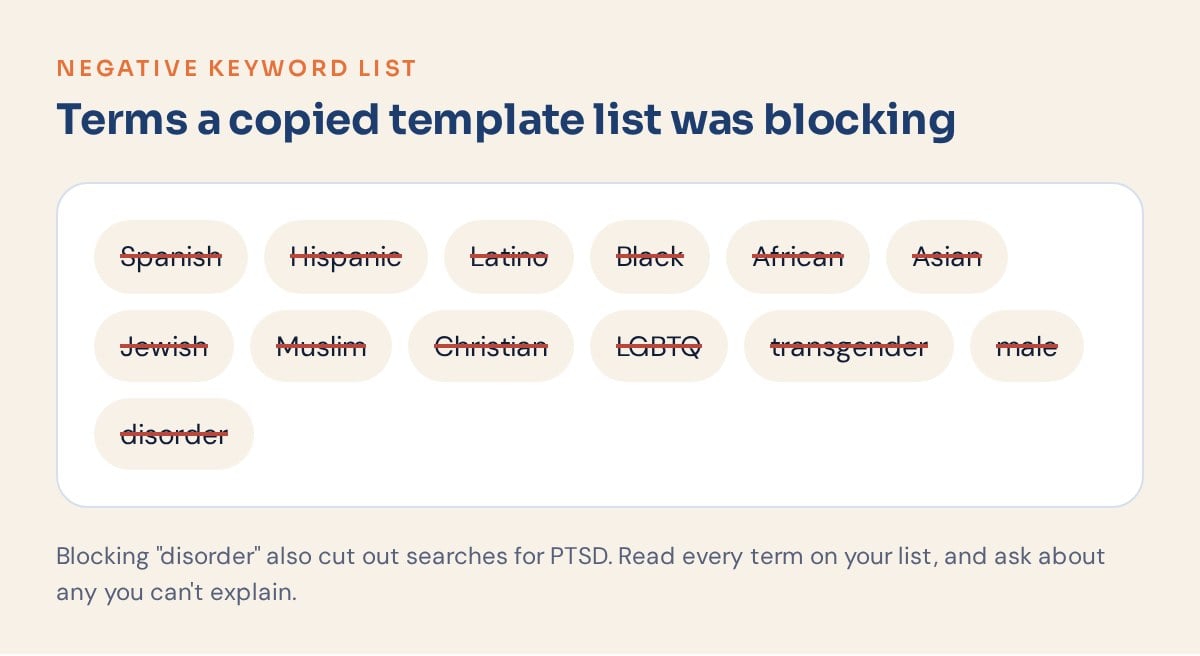
A prior agency’s template list on one account blocked these terms: Spanish, Hispanic, Latino, Black, African, Asian, Jewish, Muslim, Christian, LGBTQ, transgender, and male. It also blocked “disorder,” which cut out searches for PTSD. The practice is in a county where over half of residents are Hispanic.
Open your negative keyword list and read every term on it. If you can’t tell why a word is there, ask.
Keep Ownership of Your Accounts
Your practice should own its Google Ads account, Google Analytics 4 (GA4), Google Tag Manager, and Google Business Profile. Vendors should get their own logins with the access they need, and you should never share yours.
Each platform makes this possible. Google Ads offers several access levels, and Google recommends adding at least one additional administrator so you don’t lose access if one person becomes unavailable. On a Google Business Profile, owners and managers have different rights: managers can’t add or remove users. In Google Analytics, users are managed from Access Management, which requires the Administrator role.
When a client asked us what happens to their account if we part ways, William’s answer was: “I’d just let you keep using it free of charge and we can remove our access levels. No sweat at all, that’s written into our contract.” We use our own logins “to avoid logging in with your credentials and 2FA issues.”
Sign a BAA First
Before any vendor touches your systems, sign a business associate agreement (BAA). HHS publishes sample business associate agreement provisions and explains that covered entities generally need these contracts so business associates appropriately safeguard protected health information. One client described our rule this way: “William’s team refuses to touch anything until it’s signed.”
Questions about how we handle access and compliance? Our FAQ answers the questions practice owners ask us most, from compliance to reviews to what happens on a fit call. Read the W&F FAQ.
Frequently Asked Questions About Hiring a Marketing Agency
How do I choose a marketing agency for a therapy practice?
Look for experience in behavioral health, clear answers about where every number comes from, and reporting that goes past clicks to booked and retained clients. Ask who will own your accounts and whether they’ll sign a BAA before touching anything. An agency that answers those questions plainly, in writing, is usually easier to work with later.
What should a Google Ads audit check?
Start with the conversion actions, so you know what the account is counting. Then read the change history, the placements report, the location settings, and the negative keyword list. Those five checks show whether the account is being worked, where the money went, and whether anything is blocking the clients you want.
Who should own my Google Ads account?
Your practice should. Keep the account under your own login, add your agency as a user with the access level it needs, and follow Google’s advice to have more than one administrator. The same goes for Google Analytics 4, Google Tag Manager, and your Google Business Profile.
Does a marketing agency need to sign a BAA?
If the agency will touch systems that hold protected health information, like your EHR, CRM, or intake forms, HHS guidance says covered entities generally need a business associate agreement with that vendor. Sign it before any access is granted, and check with your compliance counsel if you’re not sure whether a vendor counts.
8 Agency Checks Every Practice Owner Should Know
Save this list for your next agency conversation, or your next account review.
-
Raw data: can you see what’s behind every number?
-
Break-even math: does it include ad spend?
-
Local or national: where does each figure come from?
-
AI checks: which tools, and on what dates?
-
Reporting: can they track inquiry to retained client?
-
Change history: who’s making the changes?
-
Placements and locations: where did the money go, and where did the ads run?
-
Ownership: does your practice hold every account, with a BAA in place?
Bring the list to your next account review.
Conclusion
The questions to ask a marketing agency are the same ones you’d ask about any big decision for your practice: what’s this based on, who’s doing the work, and what happens if it doesn’t work out. Asking them up front and then checking the account afterward gives you a clear view of what you’re paying for.
At William & Friends, William Turner, Amaury, and Carlos run a small Denver team built around behavioral health practices, and we only hire people with experience in behavioral health. We answered 17 questions from one prospect, and we’d be glad to answer yours.
Start the conversation Bring your hardest questions. We’ll use the call to see whether we’re a good fit for your practice, and if we’re not, we’ll say so. Book a fit call.