

If you’re figuring out how to rank on ChatGPT, start with your Psychology Today listing. For many practices, directory listings shape what AI tools say more than the practice’s own website does. One practice we audited showed up in just 2 of 810 Google Maps checks. In ChatGPT, it was named in about 59 to 66 of 81 checks, at an average position between 1.0 and 2.4.
ChatGPT got its information from directory listings, and it repeated an old detail 16 times: a “free 15-minute consultation.” The practice’s real consult is 55 minutes. At William & Friends, our AI search optimization work starts with what AI tools already believe about a practice, and it covers two sides: what AI tools say about you, and what your own AI tools say to the people who contact you.
TL;DR
AI assistants like ChatGPT, Perplexity, and Gemini build their answers about therapy practices from what they find on the web, and directory listings like Psychology Today and TherapyDen are a big part of that. If a listing is out of date, AI tools will repeat the old details. Audit every directory listing and fix errors at the source, respond to suggested edits on your Google listing within 4 days, and put your FAQ answers in plain text on the page so crawlers can read them. If you use an AI chat tool on your own site, say so in the first message, and check your state’s rules before adding one, since Colorado and Rhode Island have both passed laws on AI and therapy.
Key Points
-
AI tools read your directory listings. ChatGPT pulls practice details from Psychology Today, TherapyDen, and similar sites.
-
Old details travel. An outdated consult length can show up in answer after answer.
-
Fix errors at the source. Update the directory listing itself as well as your website.
-
Watch for suggested edits. Google gives you 4 days to accept or reject them.
-
Keep FAQs in plain text. Answers that only load after a click may not be read.
-
Disclose AI chat tools right away. People should know they’re talking to software.
-
Check your state’s rules. Colorado and Rhode Island have both acted on AI and therapy.
How to Rank on ChatGPT: Where AI Tools Get Their Answers
When someone asks ChatGPT for a therapist near them, it can search the web for current information. Some marketers call the work of showing up in those answers ChatGPT SEO or LLM SEO. For a therapy practice, most of it comes down to the accuracy of what’s already published about you. According to OpenAI’s help page on ChatGPT search, responses that use web search may include citations to their sources. The same page notes that a website is eligible for inclusion when it allows OAI-SearchBot to crawl it, so it’s worth confirming your site and hosting provider don’t block it.
In practice, directory listings carry a lot of weight in those answers. The practice we mentioned above barely showed up on Google Maps, yet ChatGPT named it in most of our checks, because ChatGPT was working from its directory listings. The catch was that one of those listings still advertised a 15-minute consult. Our line from that audit: “You do not own those listings. You rent them.”
AI-written answers are also taking up more of Google itself. Search Engine Roundtable reported that, according to AlsoAsked, 97% of People Also Ask answers in the first week of September 2026 were AI Overviews, up from 86% in August. That figure covers every kind of search, therapy included.
Audit Your Psychology Today Listing and Other Directories
Start with your Psychology Today listing, then work through TherapyDen and any other directory where your practice or clinicians appear. Read each one the way a prospective client would, and check these details against what’s true today:
-
Consultation length and whether it’s free
-
Session fees and insurance plans accepted
-
Specialties and the populations you serve
-
Clinician names, titles, and availability
-
Address, phone number, and telehealth options
When something’s wrong, fix it on the directory itself. Updating your website helps, and AI tools may still pull from the listing that’s been live for years. If you’re weighing where else to be listed, our guide to Psychology Today alternatives covers where clients are looking now.
Respond to Suggested Edits Within 4 Days
Your Google Business Profile needs the same attention. Google’s page on Google updates to your Business Profile says that once you’re notified of a suggested edit, you have 4 days to accept or reject it. If you don’t respond, Google may publish the update automatically when it’s supported by other public information, such as your website. Search Engine Roundtable covered the change in September 2026.
Check your profile notifications at least twice a week so no suggestion sits past the deadline.
Keep Your Name, Address, and Phone Consistent
AI tools and search engines compare what different sources say about you. Keep your practice name, address, and phone number identical across your website, your Google Business Profile, Psychology Today, TherapyDen, Zencare, GoodTherapy, and Inclusive Therapists. Check each clinician’s record in the NPI Registry too, since it’s a public source of provider names and practice locations.
See how we approach AI search for practices We check what AI tools say about your practice, then fix the listings and pages they rely on. Learn about our AI search optimization.
Keep Your FAQs Readable
In one audit, a service page’s entire FAQ sat inside dropdowns that AI crawlers may not read. The answers were good. They just weren’t reliably visible to anything that doesn’t click.
Google’s guidance on mobile-first indexing says Google won’t load content that requires user interactions like swiping, clicking, or typing to load. Its JavaScript SEO basics add that not all bots can run JavaScript. Tabs and accordions can be fine when the text is already in the page. The problem comes when the answer only loads after someone clicks.
Put your FAQ answers in plain text in the page itself. Then make sure the questions are the ones people actually ask, like whether you take their insurance, what a first session looks like, how long the wait is, and whether telehealth is available.
Questions about how we work? Our FAQ answers the questions practice owners ask us most, from compliance to reviews to what happens on a fit call. Read the W&F FAQ.
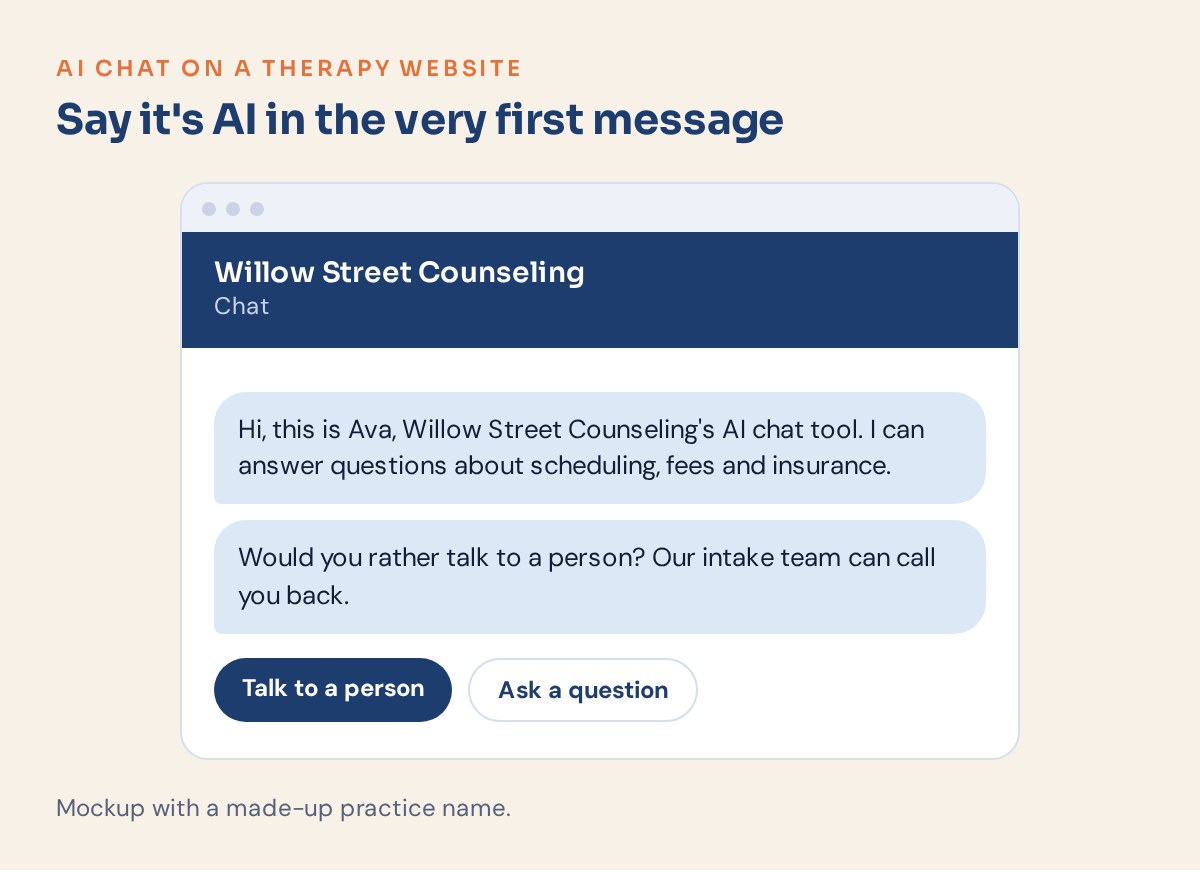
If You Use an AI Chat Tool, Say So in the First Message
Some practices have added AI chat tools to their websites. If yours has one, open with a line that says it’s AI. William’s advice to one client was to add something like “Hi, this is x, [Practice]’s AI chat tool.” A person reaching out about therapy should know from the first line whether a person or software is answering.
Another client decided against AI voice agents entirely over compliance concerns with the vendors behind them. For client-facing steps, we build with traditional intake automation: auto-responders, calendar sync, and templated confirmations that run inside clean BAA setups.
What the New State Laws Say
Colorado’s HB26-1195 became law this year. The Colorado General Assembly’s bill summary says it makes it an unfair or deceptive trade practice to use any term, letter, or phrase with an AI system in a way that indicates or implies its outputs are provided by, endorsed by, or equivalent to services from a regulated professional, or that represents the AI system provides psychotherapy. The Governor signed it on June 3, 2026, and its effective date was August 12, 2026.
Rhode Island’s 2026 S 2197 says an individual or entity may not provide, advertise, or otherwise offer therapy or psychotherapy services, including through internet-based AI, unless a licensed professional conducts them. Rhode Island Current reported that it was signed into law in June 2026. Rules vary by state, so check yours with your own counsel before adding any AI tool that talks to clients.
How People Feel About Chatbots
Public opinion leans cautious. In a Pew Research Center survey, 39% of U.S. adults said chatbots do more to hurt people using them for loneliness, while 19% said they do more to help. The American Psychological Association’s health advisory is direct: “Do not rely on GenAI chatbots and wellness apps to deliver psychotherapy or psychological treatment.”
Frequently Asked Questions About ChatGPT and Therapy Practices
How do I get my therapy practice recommended by ChatGPT?
No one can guarantee a recommendation, and anyone who promises one is guessing. What you can control is the accuracy and consistency of what’s published about you: directory listings, your Google Business Profile, and a website that states the facts plainly and doesn’t block AI crawlers like OAI-SearchBot.
Where does ChatGPT get information about therapists?
When it searches the web, ChatGPT pulls from pages it can find and read, and it may cite them. In the audit described above, directory listings carried more weight than the practice’s own site.
Does my Psychology Today listing affect what ChatGPT says?
In the practice we audited, it did. ChatGPT repeated a “free 15-minute consultation” 16 times, a detail that came from an outdated listing, when the real consult is 55 minutes. Fixing the listing itself is the most direct way to change what AI tools repeat.
Do I have to disclose an AI chatbot on my therapy website?
Rules vary by state, and Colorado and Rhode Island have both passed laws touching AI and therapy this year. Our advice for every practice is the same: say it’s AI in the first message, and review any client-facing AI tool with your own counsel before it goes live.
7 AI Visibility Checks Every Practice Owner Should Know
Work through these once a quarter.
-
Directory listings: read each one as a stranger would.
-
Consult details: length, cost, and format match what you offer today.
-
Suggested edits: check Google notifications twice a week and respond within 4 days.
-
FAQ text: answers sit in the page text, visible without a click.
-
Crawler access: your site doesn’t block the bots AI tools use.
-
Consistent details: name, address, and phone match everywhere.
-
AI chat disclosure: the first message says it’s AI.
The details AI tools repeat about you are mostly details you can edit.
Conclusion
Learning how to rank on ChatGPT mostly means taking care of what’s already published about you. Your Psychology Today listing, your other directory profiles, and your Google Business Profile are now part of how AI tools describe your practice to people who’ve never heard of you. Keeping them accurate, making your FAQs readable, and being upfront about any AI on your own site all help those descriptions match reality. Ask ChatGPT about your practice today and compare the answer with what your intake coordinator would tell a caller.
At William & Friends, William Turner and our Denver team work only with behavioral health practices, and we only hire people with experience in the field. We check what AI tools say about a practice before recommending anything.
Tell us about your practice If you’re curious what AI tools are saying about you, let’s talk. We’ll use the call to see whether we’re a fit, and if not, we’ll point you somewhere better. Book a fit call.
