

Google Ads conversion tracking for therapists can make an account look healthy while the calendar stays the same. One account we opened reported a “$43 cost per conversion.” The conversions were page views. Our Google Ads strategist put it simply: the numbers “look better than they feel in real life.”
We found some version of this problem in 4 of the ad accounts we’ve opened since August 2026. At William & Friends, our marketing analytics work for therapy practices starts by checking what an account is actually counting, before we change a single bid or keyword.
TL;DR
A Google Ads account is only as honest as its conversion setup. Many practice accounts count page views, button clicks, or duplicate actions as conversions, which makes cost per lead look far better than it is and teaches Google to chase the wrong thing. A conversion should be a form submission or a call from an ad click, and only real leads should be marked as primary. Branded searches, where people type your practice name, belong in their own campaign so they don’t flatter everything else, and auto-applied recommendations should be turned off. From there, track leads all the way to booked clients by matching your EHR data back to campaigns, and agree on a realistic benchmark before month one so everyone judges results against the same number.
Key Points
-
A conversion should be a real lead. A form submission or a call from an ad click.
-
Page views and button clicks don’t count. Neither do duplicate actions.
-
Primary means Google bids on it. Mark only real leads as primary.
-
Branded searches get their own campaign. People searching your name were already looking for you.
-
Turn off auto-applied recommendations. Otherwise Google can change your campaigns on its own.
-
Track to booked clients. A form fill can end before intake does.
-
Agree on a benchmark first. For mental health landing pages, 8 to 12% is strong.
Google Ads Conversion Tracking for Therapists: Check What It Counts
Google lets each advertiser decide what counts as a conversion. In Google’s own words from its conversion measurement overview, “You choose what you identify as valuable, like a purchase, sign-up, or phone call.” That flexibility is useful, and it’s also where most of the problems start.
Here’s what we’ve found in practice accounts. One counted page views as conversions, which produced the “$43 cost per conversion.” Another counted a button click. A third had 14 conversion actions, all set as primary, and none of them recording anything at all.
What Should Count
For a behavioral health practice, a conversion should be a form submission or a call that came from an ad click. Everything else, like visiting a page, clicking a button, or scrolling, can be useful to observe, but it isn’t a lead. Duplicate actions that fire twice for the same person inflate the count too. Whether your tags run through Google Tag Manager, Google Analytics 4, or the Google Ads tag directly, the same rule applies: count leads.
Why “Primary” Matters
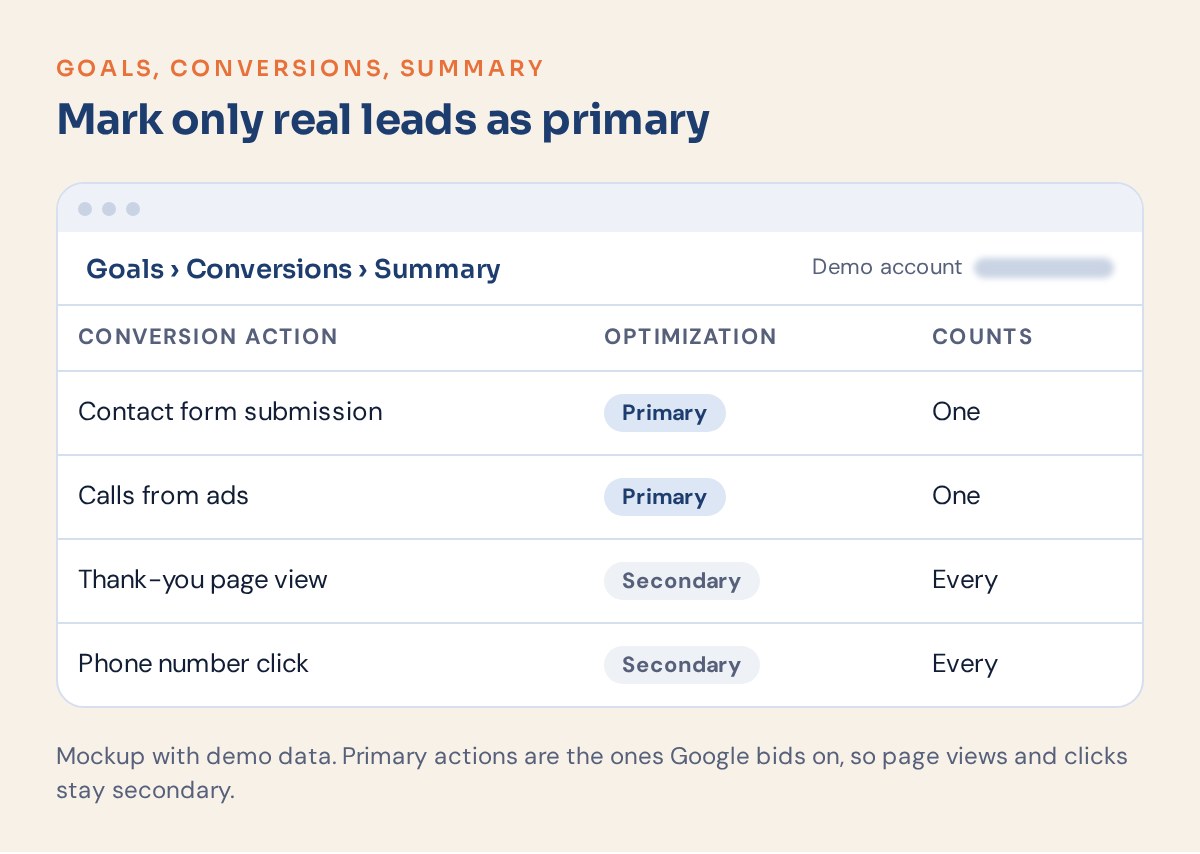
Google splits conversion actions into primary and secondary. According to Google’s page on primary and secondary conversion actions, primary actions are reported in the “Conversions” column and used for bidding, while secondary actions are for observation only. Google bids toward everything marked primary, so if a page view is primary, the account learns to buy page views.
Our build SOP puts it this way: “A campaign with a broken conversion is worse than no campaign.” To check yours, open Goals in Google Ads, then Conversions, then Summary, and look at which actions are marked primary.
See how we set up Google Ads for practices We check conversion tracking before any campaign goes live, so the account learns from real leads from day one. See our approach to Google Ads for therapists.
Put Branded Keywords in Their Own Campaign
A branded search is when someone types your practice’s name into Google, and branded keywords are the ones that match it. Non-branded keywords are everything else, like “couples therapy near me” or “grief counseling.” Those people were already looking for you, often because a friend, a doctor, or a directory listing sent them your way. When branded searches sit in the same campaign as everything else, they make the whole campaign look stronger than it is.
On one account, 7 of 8 recent conversions came from people searching the practice’s name. Over 12 months, branded searches were 44% of spend and 68% of conversions. Our strategist split brand into its own campaign so the rest of the account could be judged on its own results.
Google has tools that help keep this separation clean. Its brand settings for Search and Performance Max include brand exclusions, which stop a campaign from serving on searches for a brand you want to avoid, and a brand list can include your own business name.
Turn Off Auto-Applied Recommendations
The second setting to check is auto-applied recommendations. In plain words: when they’re on, Google can change your campaigns on its own. Google’s page on applying recommendations automatically lists changes like adding broad match keywords and setting a target CPA among the recommendations that can apply this way.
Our strategist’s view is that auto-applied recommendations “kill campaigns.” Google’s instructions for managing auto-apply show you can turn them off at any time in the auto-apply settings. With them off, every change in the account has a person and a reason behind it.
Track All the Way to Booked Clients
The last step in Google Ads conversion tracking for therapists happens outside Google Ads. A form submission is a good start, and it’s still only the start. Someone can fill out your form and never finish intake. The number that matters to a practice is booked clients.
Match Your EHR Back to Your Campaigns
One practice we work with has two forms: ours on the landing page and their EHR’s intake form. The EHR doesn’t connect to ad reporting, so we match its monthly export back to the campaigns by hand. It’s slow, and it’s how you find out which ads actually produced clients.
Offline Conversion Tracking and Enhanced Conversions for Leads
We also set up offline conversion tracking for that practice. When the owner moves a lead to “closed won” in the CRM, Google learns that the click became a client. Google’s page on offline conversion imports describes the idea: measuring what happens after your ad results in a click or call. The owner has confirmed that both of the first two leads from a new page booked.
For new setups, that same Google page recommends starting with enhanced conversions for leads. According to Google’s overview of enhanced conversions for leads, it uses hashed, user-provided data such as email addresses to match imported conversions back to the ad that drove them. That means contact details from your lead form are part of the setup, so it deserves a careful look. We run enhanced conversions through a dedicated tool that hashes the data before it leaves your site, and we still recommend every practice review its setup with its own compliance counsel.
Report on the Stages That Matter
A prospect once asked us for reporting from inquiry to scheduled consult, attended consult, new client, and retained client. Another client’s contract lead asked to track cost per established client. We build reporting around those stages. Our EHR integration work is often what makes that reporting possible.
A Note on Privacy and Tracking
The rules around tracking on health care websites have shifted in the last few years. HHS’s guidance on online tracking technologies notes that on June 20, 2024, a federal court vacated a portion of that guidance, and the American Hospital Association reported that HHS would not appeal. HIPAA itself didn’t change. Before you connect any CRM or EHR data to an ad platform, talk with your own compliance counsel about what your setup sends and where.
What’s a Good Google Ads Conversion Rate for a Therapy Practice?
Without a shared benchmark, no one knows whether month one went well. For mental health landing pages, we consider a landing page conversion rate of 8 to 12% strong, meaning 8 to 12% of ad clicks turn into a form submission. For ad click-through rate, we look for 4 to 6%. Agree on both numbers before month one.
One practice came to us expecting a 50% conversion rate because someone had told them that was normal. We corrected that expectation early, because a practice judging a healthy campaign against an impossible number will turn it off before it has a chance to work.
For reference, our rebuilt couples landing page converted 10% of ad clicks in its first 4 days, as of Sep 22, 2026. That account’s click-through rate was about 3.5% in its second week, and by week three it was above average.
Want reporting you can trust? We build reporting from inquiry to booked client so you can see which campaigns fill your caseloads. See how our marketing analytics work.
Frequently Asked Questions About Google Ads Conversion Tracking
What should count as a conversion for a therapy practice?
A form submission or a phone call that came from an ad click. Page views, button clicks, and scroll depth can be tracked as secondary actions for observation, but they shouldn’t be treated as leads or used for bidding.
What’s the difference between primary and secondary conversions in Google Ads?
Primary conversion actions show up in the Conversions column and are used for bidding. Secondary actions are for observation only. If a page view is marked primary, Google will optimize your campaigns toward page views, so keep primary actions limited to real leads.
Should branded keywords be in a separate campaign?
Yes. People searching your practice name were already looking for you, so branded keywords tend to convert well and can make the rest of the account look better than it is. A separate campaign lets you judge non-branded keywords on their own results.
How do I track which ads turn into booked clients?
Match your EHR’s monthly export back to your campaigns, and mark booked leads in your CRM so Google can learn from them through offline conversion tracking. Review any setup that sends lead data to Google with your compliance counsel first.
6 Google Ads Checks Every Practice Owner Should Know
Run these on your account this week, or ask whoever manages it to walk you through them.
-
Conversions: only form submissions and calls from ad clicks.
-
Primary actions: only real leads.
-
Where to check: Goals, then Conversions, then Summary.
-
Brand: branded searches in their own campaign.
-
Auto-apply: turned off.
-
Booked clients: matched back to campaigns every month.
If any of these come back wrong, your cost per lead is probably telling you a better story than your calendar is.
Conclusion
Good Google Ads conversion tracking for therapists comes down to counting the right things. When conversions mean real leads, branded searches sit in their own campaign, and booked clients are matched back to the ads that brought them, the numbers in the account start to line up with what you see in your schedule.
William Turner founded William & Friends in Denver, and Amaury, our Head of Growth Strategy, leads the data side of every account we manage. We only hire people with experience in behavioral health, and we report the number your calendar would confirm.
Tell us about your practice If you’re not sure what your ad account is counting, let’s talk it through. We’ll use the call to see whether we’re a fit, and if we’re not, we’ll tell you. Book a fit call.