

Your therapy intake process starts the moment someone decides to reach out, which is usually days before anyone on your team schedules a first session. A caller at one counseling center we work with told the front desk she’d tried fourteen other clinics, and theirs was the first place where a person picked up. She said it twice: “you answered the phone.”
That first week decides whether an inquiry becomes a client. At William & Friends, we build intake automation for behavioral health practices, and most of that work comes down to three things: the phone, the follow-up, and the wait.
TL;DR
People who contact a behavioral health practice are often contacting several at once, and the first week after that first contact decides where they land. Three parts of the intake process do most of the work. Answer or return calls quickly and know your missed-call rate, especially now that Google’s Local Services Ads charge for some missed calls. Send automated follow-up emails that sound like the way you already reply, stop them the moment someone books, and keep them to new inquiries only. Then count the days from inquiry to first session and tell people that timeline up front, because research on behavioral health referrals shows attendance drops as the wait gets longer.
Key Points
-
The phone is often the first test. Many callers are working down a list, and a person picking up can decide where they book.
-
Know your missed-call rate. Since Oct 1, 2026, Local Services Ads can charge for missed calls during business hours.
-
Your voicemail should name a time. Say when you’ll call back, then do it.
-
Follow-up emails should sound like you. Build them from the way you already reply to inquiries.
-
Three emails, then stop. One right away, one a day later, one two days after that, and nothing once they book.
-
New inquiries only. Former clients never belong in an inquiry sequence.
-
Count the days to a first session. Longer waits are linked to lower attendance.
-
Say the timeline out loud. People who know what’s coming are less likely to book somewhere else while they wait.
Why the First Week of the Therapy Intake Process Matters
Someone looking for a therapist right now has good reason to contact more than one practice. In the APA’s 2025 Practitioner Pulse Survey, about half of practitioners (46%) reported having no openings for new patients, and 40% had a waitlist. When openings are hard to find, people send several inquiries and go with whoever responds first with a real time slot.
The wait itself also changes whether people show up. A study of 1,587 behavioral health referrals published in Psychological Services found that each additional week between the referral and the scheduled appointment was associated with a 5% decrease in the odds of attendance. A 2026 meta-analysis in Psychiatric Services put the pooled rate of nonattendance at a first outpatient mental health appointment at about one in three.
Put those together and the first week carries a lot of weight. The phone call, the email that follows, and the date you can offer are the parts of your intake process a new client actually experiences, and all three are within your control.
See how intake automation fits a group practice The follow-up, confirmations, and reminders can run on their own once they’re written well. See how we build intake automation.
Know Your Missed-Call Rate
Missed calls have always cost practices clients. As of Oct 1, 2026, they can also cost money. According to Search Engine Land, Local Services Ads now charge for missed calls during business hours when the caller stays on the line for more than 20 seconds, with some exceptions. Google’s Ads Liaison added that the advertiser will be charged once for any follow-up calls they make to the same person within 15 days, as Search Engine Roundtable reported.
Google’s own help page on how Local Services Ads charge also notes that lead credits aren’t available for health care verticals. If you run these ads, a missed call is now a paid lead you didn’t answer.
Whether or not you run Local Services Ads, the missed-call rate is worth knowing. Most phone systems can show how many calls went unanswered each week and at what times. If the misses cluster around lunch, the end of the day, or the first hour after you open, that’s a staffing and scheduling question you can solve.
What Your Voicemail Should Say
A voicemail that says “leave a message and we’ll get back to you” leaves the caller guessing. Name a time instead: “We return every call by the end of the next business day.” Then build the callback into someone’s day so it actually happens.
If the practice can’t answer live during certain hours, say so in the greeting and point people to the online form or booking link. The goal is for the caller to hang up knowing exactly what happens next.
Set Up a Missed Call Text Back
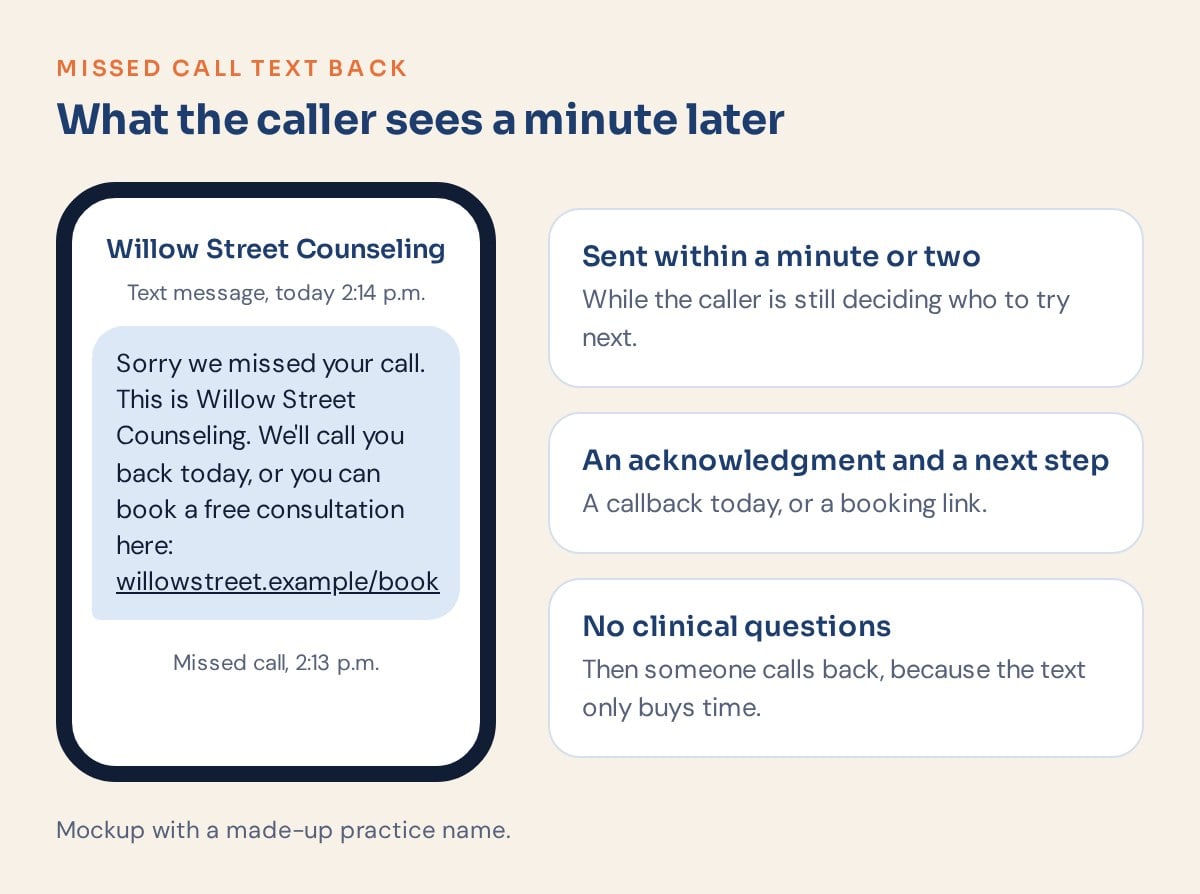
A missed call text back sends a short text to anyone whose call goes unanswered, usually within a minute or two. It tells the caller they reached a real practice and gives them a next step while they’re still deciding who to call next. It’s part of the intake automation we build for practices.
Keep the text to an acknowledgment and a next step, with no clinical questions: “Sorry we missed your call. This is [Practice]. We’ll call you back today, or you can book a free consultation here: [link].” Then make sure someone actually calls back, since the text only buys you time.
Write Follow-Up Emails the Way You’d Reply Yourself
Automated follow-up works best when it sounds like the owner or the intake coordinator wrote it on a good day. Most practices already have a way they answer inquiries. The automation should start there.
Start From How You Already Answer Inquiries
When we rebuilt one owner’s follow-up sequence, we started by asking how he actually replies when someone reaches out. His reply welcomes the person, says he’s glad they reached out, and offers a free 55-minute consultation to talk through what’s bringing them in. That became the backbone of every automated email.
For a financial therapist client, we wrote the subject line “[First name], do you need a second set of eyes?” and included the line “If it turns out you do not need me, I will say so on the call.” His reaction: “I love the emails.” The tone matched how he talks to people, so the sequence read like him.
A Simple Three-Email Sequence
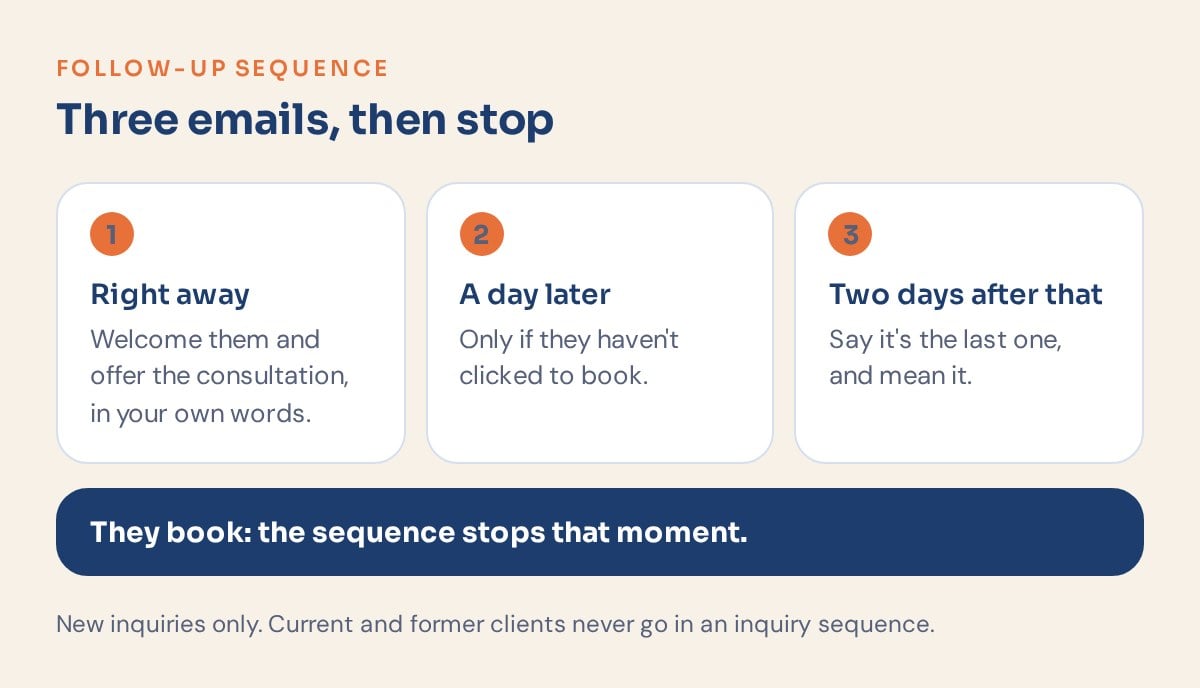
Here’s the cadence we use for new inquiries. The first email goes out right away. The second goes out a day later if they haven’t clicked to book. The third goes out two days after that.
Stop the sequence the moment someone books. If the third email is the last one, say so, and mean it. Many people take a week or more to decide on therapy, so the sequence gives them room without filling their inbox.
The Lines to Cut
One owner asked us to cut this line from his sequence: “I’m not going to keep chasing you.” It’s common in sales emails. To someone deciding whether to start therapy, it reads as pressure.
Read each email the way a person in a hard week would read it. Anything that sounds like a countdown, a guilt trip, or a sales tactic comes out.
Keep the List Clean
Inquiry sequences are for new inquiries only. Former clients never belong in them, and neither do current clients. That boundary protects the therapeutic relationship and keeps your marketing clearly separate from care.
Give every automated email a clear way to stop. The FTC’s CAN-SPAM compliance guide says businesses must honor opt-out requests within 10 business days, and an easy unsubscribe also keeps the tone respectful. One more practical note: when you edit an email, check every automation that sends it, since the same message often lives in more than one workflow.
Keep booked appointments on the calendar Once someone books, reminders and easy rescheduling keep the appointment on the calendar. Read how practices reduce no-shows.
Count the Days From Inquiry to First Session
The number to track here is simple: how many days pass between the form fill and the first session. Most practices have never counted it.
A large group practice we work with runs a careful intake: the form, a benefits check (insurance verification), an intake specialist, then clinician matching. It takes 6 to 7 days. Their reason: “Our goal is to make sure you’re not just placed with the next available clinician.”
What makes a longer therapy intake process work is telling people about it. When someone knows the steps and the timeline up front, they have less reason to book elsewhere while they wait. Confirm the next step the same day, even if the first session is a week out. Another practice we work with has its office manager call every inquiry right away, which does the same job by a different route.
For context, the APA’s 2025 survey data tables show 61% of practitioners said a new client gets an appointment in less than a month, and 26% said one to three months. If your practice can offer a first session within a week or two, say that clearly.
Some larger organizations are testing other routes. Fierce Healthcare reported that Pelago, which sells to employers and health plans, now starts intake and triage with an AI agent available by voice and text. For most group practices, the simpler path works well: a clear timeline, a same-day reply, and traditional automation that confirms each step. When we connect booking to a practice’s EHR through our EHR integration work, the goal is fewer handoffs between the inquiry and the first session.
Frequently Asked Questions About the Therapy Intake Process
How long should the therapy intake process take?
There’s no single standard, and a careful process can be worth the wait. The large group practice above takes 6 to 7 days because it matches every client with the right clinician. What matters most is that people know the timeline up front and hear back the same day, since longer waits are linked to lower attendance.
What’s the difference between a therapy intake form and the intake process?
The therapy intake form is the paperwork: history, consent, insurance, and contact details, usually completed in your EHR’s client portal. The intake process is everything from the first call or form fill to the first session, including the consultation, benefits check, and clinician matching. Keep the contact form on your website short and let the full intake form live in the EHR.
Should a therapy practice offer a free consultation?
Many practices do, and it can make the first step feel easier for someone who’s nervous about starting therapy. One owner we work with offers a free 55-minute consultation, and it anchors every follow-up email he sends. Whatever you offer, describe it the same way everywhere, because directories and AI tools repeat whatever length and price they find.
How many follow-up emails should a practice send after an inquiry?
We use three: one right away, one a day later if the person hasn’t booked, and one two days after that. The sequence stops the moment someone books, and the last email says it’s the last one. That gives people room to decide without filling their inbox.
8 Intake Habits Every Practice Owner Should Know
These are the habits that keep an inquiry moving toward a first session.
-
Track missed calls weekly. Know how many, and at what times.
-
Name a callback time. Put it in your voicemail greeting and keep it.
-
Text back missed calls. A short acknowledgment within minutes, then a real callback.
-
Build follow-up from your own replies. The best automated email sounds like you.
-
Three emails, then stop. Right away, a day later, two days after that.
-
Stop the moment they book. No one should get a nudge after they’ve scheduled.
-
New inquiries only. Keep current and former clients out of every sequence.
-
Publish your timeline. Tell people how long it takes to reach a first session.
Run through this list once a quarter.
Conclusion
The first week after someone reaches out is short, and it decides a lot. Answering the phone, sending a follow-up that sounds like a person, and being clear about when the first session will happen all tell a new client something about what care at your practice will feel like. Call your own practice this week the way a new client would, and note how long it takes to learn when you could come in.
William Turner founded William & Friends in Denver to help behavioral health practices with exactly this kind of work: intake and follow-through. We only hire people with experience in behavioral health, and we build every system around the way your practice already talks to people.
Let’s get acquainted If your intake process feels like it’s losing people between the first call and the first session, we’d like to hear about your practice. We’ll talk through fit, and if it’s not a match, we’ll say so. Book a fit call.
