
Couples therapy marketing runs into something most therapy ads don’t: two people have to agree before anyone books. Our Google Ads strategist said it plainly on an account review: “Couples therapy has a lower consultation close rate because two people must agree to proceed.” He’s run couples ads before, including in New York.
The demand is real, though. In Oregon alone, “couples therapy” gets about 3,800 searches a month and “marriage counseling” about 2,900. Searches about infidelity, cheating, and rebuilding trust add up to about 2,400 more. At William & Friends, we run Google Ads for therapy practices, and couples campaigns come with three quirks worth planning for.
TL;DR
Couples therapy has steady search demand, and advertising it well means planning for three things. First, two people have to agree before a couple books, so consultations close at a lower rate, follow-up needs more time, and the page has to work when one partner forwards it to the other. Second, online therapy platforms bid heavily on couples searches, pushing some clicks to $23 to $27, so cut app-style language like “convenient” and “from anywhere” and lead with a real local practice and named clinicians. Third, people want the option to come in person even when they end up online, so target the zip codes around your office.
Key Points
-
Two people decide. Consults close at a lower rate, so plan budget and expectations around it.
-
Give follow-up more time. Couples often need longer to agree on a next step.
-
Write for the forward. The page should work when one partner sends it to the other.
-
Online platforms bid on couples searches. Some “online” and “virtual” clicks cost $23 to $27.
-
Cut app language. “Convenient,” “from anywhere,” and “on your schedule” pull you into their auction.
-
Lead with local and named. A real practice and real clinicians set you apart.
-
Target zip codes. Even if most sessions end up online.
Why Couples Therapy Marketing Needs Its Own Plan
With individual therapy, one person decides and books. With couples therapy, the person searching usually has to bring a partner along, and that partner may not be ready. We don’t have a reliable percentage for how much lower couples close rates run, so we won’t invent one. The direction is clear enough to plan around.
Research on couples backs up the pattern. A 2026 study in the Journal of Marital and Family Therapy found mixed-agenda dynamics, where partners come in with conflicting motivations, in nearly 40% of its clinical sample. In a study of an online relationship program, 52% of the people seeking help had partners who didn’t complete the enrollment form. The Gottman Institute has long cited John Gottman’s research finding that the average couple waits six years before seeking professional help.
Plan Budget and Expectations Around It
Set expectations for couples campaigns with the longer decision in mind. A couples lane may need more clicks per booked consultation than an individual therapy lane, and that’s normal. Judge it over a longer window, and compare it to other couples results. Your anxiety and depression pages are a different benchmark.
Give follow-up more time as well. A partner who wasn’t part of the first inquiry may need a few days, or a few conversations, before agreeing. Automated follow-up that’s patient and warm fits this well, and our intake automation is built to give people that room.
Write the Page for the Partner Who Wasn’t Searching
Assume your couples page will get forwarded. The partner reading it didn’t choose your practice and may be skeptical of therapy altogether. Write so that person feels welcome too: explain what a first session looks like, introduce the clinicians, and avoid language that sounds like it’s taking one partner’s side.
It also helps to set expectations about the work itself. According to the American Association for Marriage and Family Therapy, research shows marriage and family therapy is as effective as, and in some cases more effective than, standard or individual treatments for many problems, including marital distress and conflict. AAMFT also reports that the median length of treatment is 12 sessions, with 65% of cases completed within 20 sessions. Details like these help a hesitant partner picture what they’re agreeing to.
Name the Approaches and Situations You Work With
Couples often search for a specific approach or a specific problem. If your clinicians practice the Gottman Method, Emotionally Focused Therapy (EFT), or discernment counseling, name it on the page. Discernment counseling is built for exactly the mixed-agenda couples described above: according to a Journal of Marital and Family Therapy article on the approach, it’s for couples where one partner is leaning toward divorce and the other wants to work on the relationship.
Name the situations too: premarital counseling, affair recovery, rebuilding trust, and communication problems. Each one is a phrase a real couple might type, and each can support its own page later.
Planning a couples campaign? We build couples campaigns with the longer decision in mind, from budget to follow-up. See how we approach Google Ads for therapists.
In Couples Ads, Online Platforms Are in the Same Auction
Couples searches are some of the most competitive in therapy advertising. In our research, “couples therapy portland” had a 0.94 competition score, against 0.02 for problem gambling terms. Online platforms bid “online” and “virtual” couples searches up to $23 to $27 a click, and “couples therapy with insurance” ran about $18. A few stray clicks on those terms can eat a day’s budget, so those variants went on the negative keyword list.
The platforms are getting bigger, too. Universal Health Services completed its acquisition of Talkspace on Aug 17, 2026, and the release describes Talkspace’s network as approximately 6,000 licensed providers. Local practices usually can’t outbid platforms of that size, and they don’t need to.
The Three Words to Cut
Words like “convenient,” “from anywhere,” and “on your schedule” sound helpful, and they pull your ads into the same auction as the online platforms. They also describe what an app offers. Cut them from couples headlines and ad copy.
What to Lead With Instead
Lead with the things a platform can’t claim: a real local practice, named clinicians, and an office people can visit. “Meet our couples therapists in [neighborhood]” gives a reader something specific. A clinician’s name and photo give them someone to picture.
Target Zip Codes, Even If You’re Mostly Telehealth
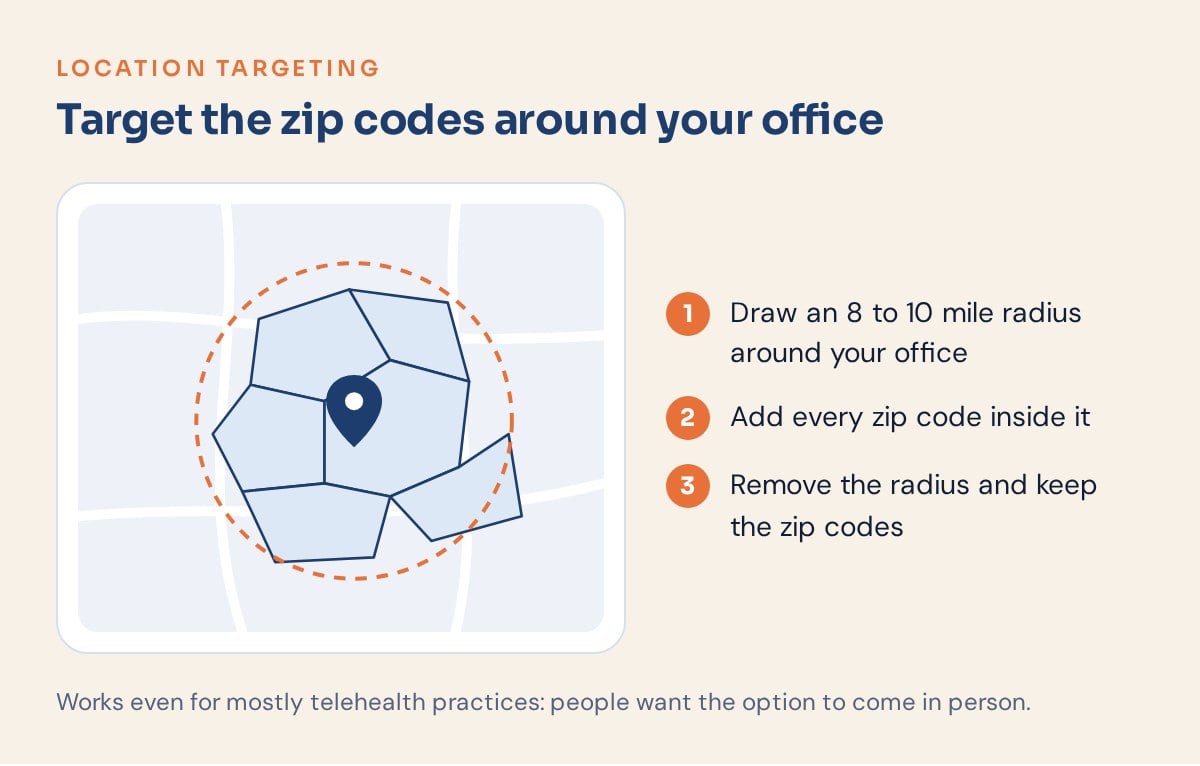
Our Google Ads strategist has used this setup on couples ads, including in New York. Set an 8 to 10 mile radius around your office, add every zip code inside it, then remove the radius. Google’s location targeting help page covers both radius targeting and targeting by postal code.
His reason: “People just want the option to come in person even if they end up doing online only.” That holds even as telehealth grows. FAIR Health’s Q2 2026 data, which covers the commercially insured population, found that 53.7% of telehealth patients were treated for a mental health condition, and 70.9% of those aged 19 to 30. A 2025 study in the Journal of Medical Internet Research found no difference in overall preference between in-person care and telehealth or digital care, which suggests many people want both options on the table.
Choose Presence Targeting
In Google’s advanced location options, the Presence setting shows ads to people who are in or regularly in your targeted locations. Google suggests considering Presence when a business is in a sensitive vertical with strict targeting limits, and therapy is one.
Follow-up that gives couples room Couples often need more time to agree on a first session. See how we build patient, warm follow-up.
How to Get More Couples Therapy Clients From Niche Pages
Not every couples search is expensive. In one plan from our July 2026 research, broad “couples therapy” ran about $9.45 a click, while “premarital counseling portland” was about $2.27, the cheapest click in the whole plan. Niche couples services can cost much less per click.
Searches about infidelity, cheating, and rebuilding trust are another example, at about 2,400 a month in Oregon. A dedicated page for couples working through an affair can speak to that situation directly, which a general couples page can’t do as well. Build the page first, then point the ads at it.
Frequently Asked Questions About Couples Therapy Marketing
How do I get more couples therapy clients?
Build a page for each couples service you offer, like premarital counseling or affair recovery, and point ads at the matching page. Name your approaches and clinicians, give follow-up more time than you would for individual therapy, and write every page so it works when one partner forwards it to the other.
Should couples therapists advertise on Google?
The demand is there. In Oregon alone, “couples therapy” gets about 3,800 searches a month. Plan for a lower consultation close rate and for competition from online platforms, and judge the campaign over a longer window than you would for individual therapy.
Why are couples therapy ads so expensive?
Online platforms bid heavily on couples searches, especially ones that include “online,” “virtual,” or “with insurance.” In our research, “couples therapy portland” had a 0.94 competition score, and online variants ran $23 to $27 a click. Adding those variants to your negative keyword list and leading with local, named clinicians keeps your budget on searches you can win.
Should couples ads target a radius or zip codes?
Our strategist’s setup uses zip codes: draw an 8 to 10 mile radius around the office, add every zip code inside it, then remove the radius. Pair that with Presence targeting so ads reach people who are actually in or regularly in your area.
7 Couples Ad Rules Every Practice Owner Should Know
Keep these in mind for any couples campaign.
-
Expect a longer decision: two people have to agree.
-
Give follow-up room: patient and warm, over more days.
-
Write for the forward: the page should welcome the partner who didn’t search.
-
Cut app words: “convenient,” “from anywhere,” “on your schedule.”
-
Lead with local: real office, named clinicians.
-
Target zip codes: 8 to 10 miles around your office, with Presence targeting.
-
Build niche pages: premarital counseling and rebuilding trust often cost less per click.
Revisit these whenever your couples capacity changes.
Conclusion
Whether you call it couples therapy marketing or marriage counseling marketing, it takes a bit more patience than other services, because the decision belongs to two people and the auction includes some very large platforms. Planning for the longer decision, leading with what makes a local practice different, and targeting the neighborhoods around your office all help your budget reach couples who are ready to start.
At William & Friends, William Turner and our Denver team work only with behavioral health practices, and we only hire people with experience in the field. We plan couples campaigns around how couples actually decide.
Tell us about your practice If couples work is part of your practice and your ads aren’t filling those calendars, we’d like to hear about it. We’ll use the call to see whether we’re a fit. Book a fit call.