
Choosing Google Ads keywords for therapists starts with a question most keyword tools can’t answer: what does someone actually type when they’re struggling? A practice owner we work with put it plainly: “Most people that are dealing with gambling problems aren’t seeing them as gambling problems.”
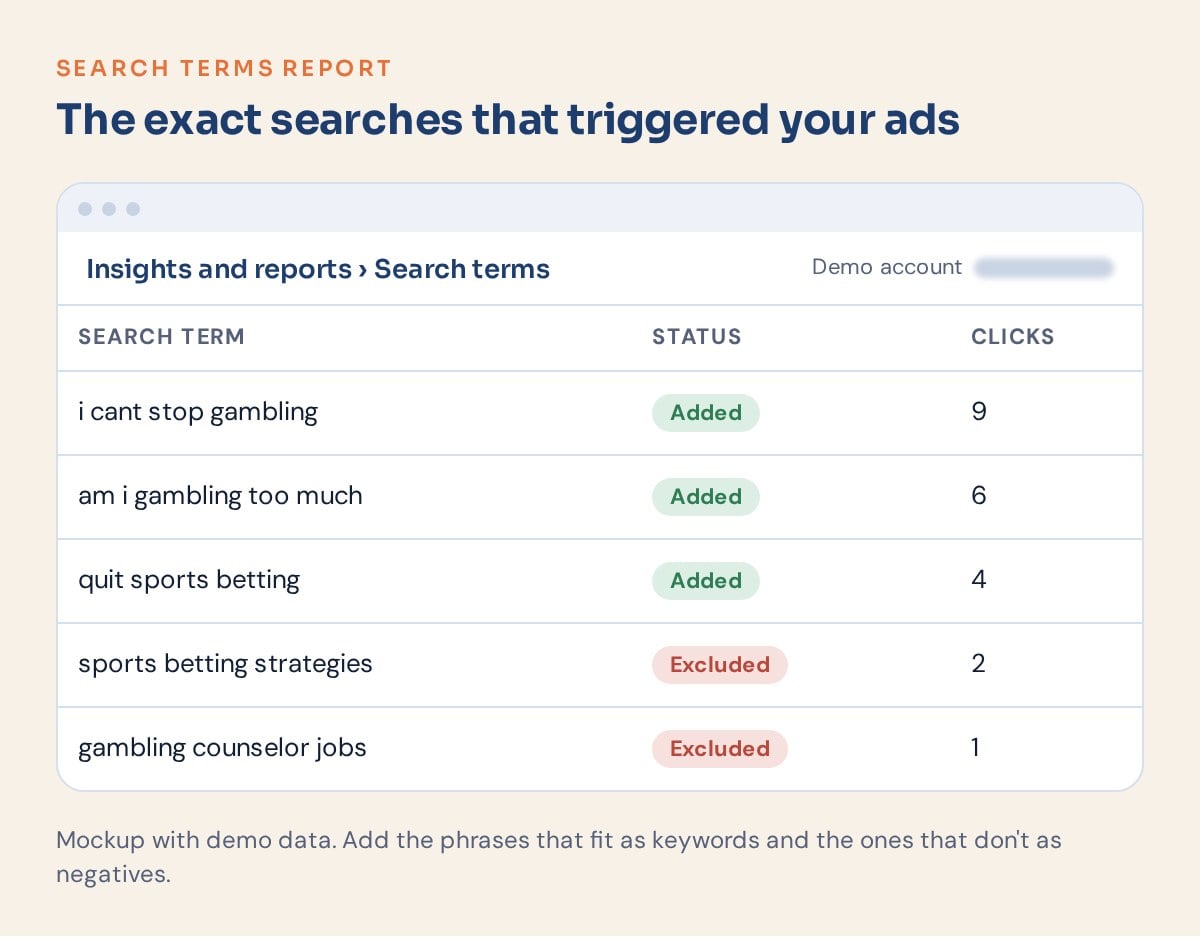
So his campaign bid on the phrases people actually use, like “how to stop gambling,” “quit sports betting,” “am i gambling too much,” and “i cant stop gambling.” At William & Friends, our Google Ads work for therapy practices starts with the words real people use, then checks the local numbers before anything gets built.
TL;DR
Good keyword choices for a behavioral health practice come from how people describe their own lives, which is rarely the way clinicians describe a condition. Bid on those real phrases, then use the search terms report after launch to see exactly what people typed and build the next round from it. Before you advertise any service, check search volume in your own market, because the same service can be busy in one state and nearly silent in another. Broad terms like “therapist near me” cost more and bring every kind of searcher, while niche local terms cost less and bring people closer to booking. Finally, keep a negative keyword list for every service, and leave out searches whose intent works against treatment, even when they’re cheap.
Key Points
-
Most people don’t search in clinical terms. Bid on how they actually phrase it.
-
The search terms report shows the real words. Build each new round from it.
-
Keyword tools miss a lot. Long, specific, and sensitive phrases often don’t show up.
-
Check local volume first. A service can be busy in one market and silent in another.
-
Low-search services need other channels. Website content and referral partners reach people who don’t search.
-
Broad terms cost more. “Therapist near me” brings every kind of searcher.
-
Some keywords shouldn’t be bought. Even cheap ones, when the intent works against treatment.
Google Ads Keywords for Therapists Should Match What People Type
The strongest keywords usually come from clients’ own language. When we asked that same owner what people type into Google, he listed a few examples from memory: “How do I deal with brain injury? Why can’t I stop gambling? How do I deal with my partners’ affair.” Each one is a question about someone’s life, with no diagnosis or treatment name in it.
The clinical terms still get searched, just differently. Nationally, “gambling counseling” gets about 390 searches a month. “Gambling addiction treatment” gets about 1,500, but most of those people are reading about the topic. Few of them are looking for a provider. According to the National Council on Problem Gambling, about 2.5 million U.S. adults meet the criteria for a severe gambling problem in a given year, and the council notes that few people with gambling disorder seek help. The people you want to reach often haven’t named the problem yet.
Research on mental health search behavior points the same way. In a study of how people search online for mental health services, 40% of participants used location-based searches like “psychological services near me,” and 26% searched by symptom. The sample was college students, and the pattern is still useful: people search by where they are and what they’re feeling.
Why Keyword Tools Miss So Much
Research tools miss long, specific phrasing, and for therapy they miss more than usual. Google’s Keyword Planner help page notes that keywords with very low search volumes, or keywords considered sensitive, aren’t discoverable or forecastable. Many of the phrases people use about their mental health fall into one of those groups.
Build the Next Round From the Search Terms Report
Once ads are live, the real words show up. Google’s search terms report shows how your ads performed on the actual searches that triggered them. Read it every week in the first month, add the phrases that fit as new keywords, and add the ones that don’t as negatives.
It also helps to understand keyword match types. Google notes that broad match is the default for every keyword and can show your ads on related searches that don’t contain the direct meaning of your keyword. Phrase match and exact match keep your ads closer to the words you chose, with exact match giving you the most control over who sees your ad. With broad match on, read the search terms report every week.
Do Google Ads Keyword Research in Your Own Market
Good Google Ads keyword research starts local. Before you advertise a service, check how many people search for it where you practice. Keyword Planner’s average monthly searches depend on the location settings you choose, so set it to the area you actually serve.
Here’s what that looks like in real numbers from our research. In Oregon, “brain injury therapist” gets about 2 searches a month. Depression after a stroke gets about 4. The whole cluster adds up to about 25 a month statewide. “Memory care” gets about 480 a month in Portland at over $7 a click, and that money goes to care facilities, which aren’t what a therapy practice offers.
The same service can be a great lane in one market and a waste in another. For a New York practice, we researched 17 services and recommended 1: couples. EMDR and trauma had essentially no local searches there. In Washington, EMDR gets about 8,100 searches a month at $1.27 to $5.24 a click. Our note to that New York client: “If the numbers don’t match what you see walking in the door, that’s worth knowing before we build anything.”
What to Do for Low-Search Services
People who don’t know therapy can help rarely search for it. The 2025 National Survey on Drug Use and Health from SAMHSA found that nearly half of adults with any mental illness did not receive any mental health treatment in the past year. Many of those people may never type a treatment term into Google.
For services like brain injury support or grief after a stroke, reach people another way. Helpful website content can answer the questions they do ask, and our SEO work for therapists focuses on those pages. Referral partners, like neurologists, rehab centers, and primary care offices, can send people who’d never search at all.
Want a keyword plan built on your market? We research search volume and costs in your area before recommending any campaign. See how we approach Google Ads for practices.
Skip Broad Terms Like “Therapist Near Me”
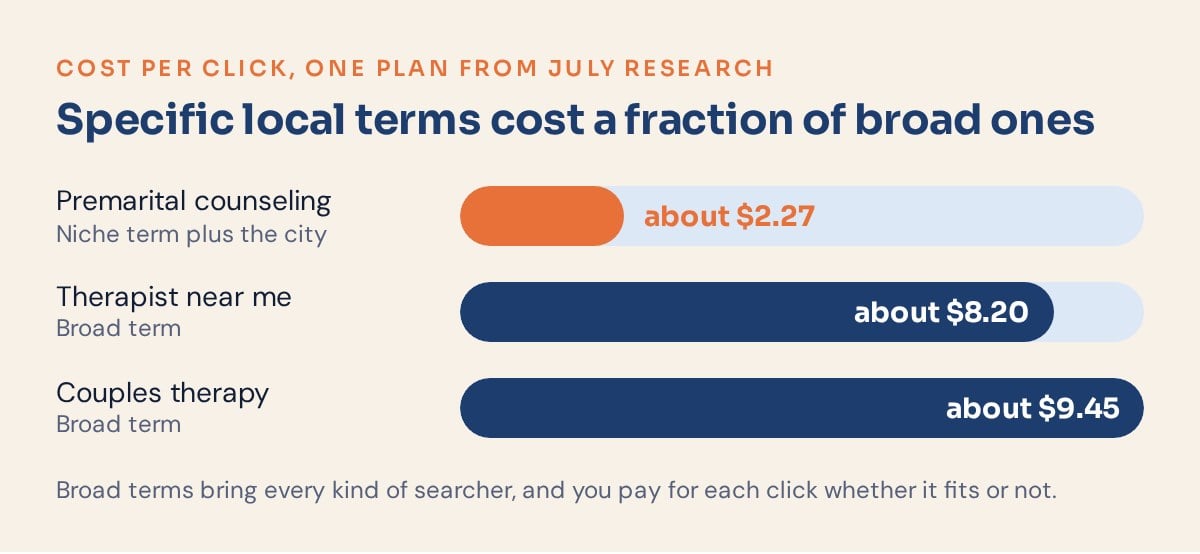
Broad terms are expensive, and they bring every kind of searcher. Someone typing “therapist near me” might want a physical therapist, a free clinic, a psychiatrist, or a couples counselor, and you pay for each click whether they fit or not.
In one plan from our July 2026 research, “therapist near me” ran about $8.20 a click, and broad “couples therapy” ran about $9.45. “Premarital counseling portland” was about $2.27, the cheapest click in the whole plan. The strategy there was to own the cheap, high-intent niche and local terms, where the person searching has already decided what they need.
Niche terms also make your ads easier to write well. When the search is specific, the headline and landing page can speak directly to it, which usually helps both relevance and cost.
Some Keywords Shouldn’t Be Bought, Even Cheap Ones
Some searches have intent that works against treatment. When we researched a problem gambling campaign, “sports betting strategies” came up as a related term. We left it out.
Those clicks would mean bidding against sportsbooks for their own customers, and reaching someone at the exact moment they want to bet. The National Council on Problem Gambling’s national survey found that 8% of American adults, almost 20 million people, reported at least one indicator of problematic gambling behavior “many times” in the past year. A practice’s ad should meet those people when they’re looking for help.
Keep a Negative Keyword List for Every Service
Negative keywords let you exclude searches from your campaigns. Every service should have its own list, and the list should grow from the search terms report. For another account, we built 82 negative keywords from their past search terms and our own research before launch.
Read your list regularly, too. Negative keyword lists can drift, and a term added for one reason can end up blocking searches you want.
A Starter Negative Keyword List for Therapy Practices
The word “therapist” shows up in a lot of searches from people who aren’t looking for care. In our SE Ranking data for the U.S., “how much do therapists make” gets about 14,800 searches a month, “how to become a therapist” gets about 12,100, and “therapist jobs” gets about 5,400. None of those people are looking to book a first session.
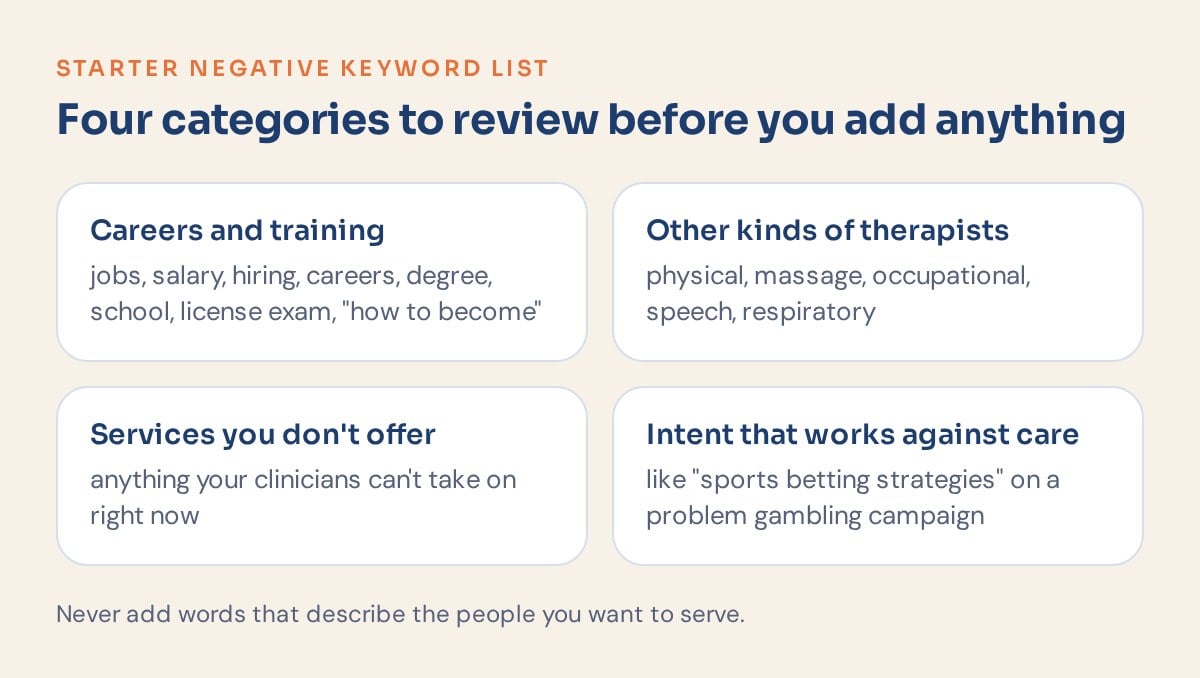
Here are the categories worth reviewing for Google Ads negative keywords on a therapy account:
-
Careers and training: jobs, salary, hiring, careers, degree, school, license exam, “how to become”
-
Other kinds of therapists: physical, massage, occupational, speech, respiratory
-
Services you don’t offer: anything your clinicians can’t take on right now
-
Intent that works against care: like “sports betting strategies” on a problem gambling campaign
Treat this as a starting point to review before anything gets added. Read every term before you add it, and never add words that describe the people you want to serve. A copied template list once blocked searches for PTSD on one account because it excluded the word “disorder.”
See what a clean account looks like Before any ad goes live, we do the groundwork: research, pages, and tracking, so everything is ready on launch day. Read how we work.
Frequently Asked Questions About Google Ads Keywords for Therapists
What are the best Google Ads keywords for therapists?
The best ones are specific and local, and they match how people describe what they’re going through. Niche terms like a specific service plus your city tend to cost less than broad terms and bring people closer to booking. Check local search volume before you build anything, then refine from the search terms report.
What negative keywords should a therapy practice use?
Start with career and training searches (jobs, salary, degree), other types of therapy (physical, massage, occupational, speech), and any intent that works against care. Build a separate list for each service, read every term before adding it, and never exclude words that describe the clients you want to reach.
How often should I check the search terms report?
Every week in the first month, since that’s when you learn the most about what people actually type. After that, a regular monthly review keeps new keywords and new negatives coming in.
Why doesn’t Keyword Planner show volume for some therapy keywords?
Google’s Keyword Planner doesn’t show forecasts for keywords with very low search volume or keywords it considers sensitive. Many mental health searches fall into one of those groups. Once ads are live, the search terms report shows you those searches.
7 Keyword Rules Every Practice Owner Should Know
Keep these in mind before your next campaign goes live.
-
Real words first: bid on how people describe their lives.
-
Search terms report: read it weekly in month one.
-
Tools miss things: sensitive and long phrases often don’t show volume.
-
Local volume: check your market before building anything.
-
Other channels: use content and referral partners for low-search services.
-
Niche over broad: specific local terms cost less and convert closer to booking.
-
Negatives: keep a list per service and leave out harmful intent.
The best keyword list usually comes from your own clients’ language, refined by what the search terms report shows.
Conclusion
Picking Google Ads keywords for therapists works best when you start from how people actually talk, check the numbers in your own market, and stay disciplined about what you leave out. That approach spends less on clicks that were never going to become clients and more on the people who are ready to book. The words your last few callers used to describe what brought them in are probably closer to your best keywords than anything a tool will suggest.
William Turner and Amaury lead strategy and data at William & Friends, a Denver team that works only with behavioral health practices. We only hire people with experience in the field, and every keyword plan we build is checked against local numbers first.
Let’s get acquainted If you’d like a second set of eyes on your keywords, we’d be glad to hear about your practice. We’ll see whether we’re a fit, and if we’re not, we’ll tell you. Book a fit call.